State regulatory agencies that oversee human care programs bear a significant responsibility in protecting vulnerable populations, enforcing laws and managing intake, licensing, provider oversight and client records. A robust case management system strengthens daily operations by streamlining complex workflows, reducing manual work and providing the tools that staff need to respond faster, make informed decisions and maintain consistent compliance with ever-evolving regulations.
Below, five essential capabilities define what every human-care case management platform must deliver.
1. Automation and Workflow Efficiency
Regulatory agencies handle large volumes of applications, referrals, renewals, complaints, audits and ongoing case oversight. Manual processes generate backlogs, duplicate effort and cause errors. A modern case management system automates repetitive tasks, such as intake forms and status updates. A digital system converts paper-heavy, error-prone processes into streamlined digital flows.
What workflow automation delivers:
- Auto-populate forms and generate common documents.
- Automatically route cases to appropriate staff.
- Flag missing or overdue documents.
- Trigger reminders for renewals or follow-up.
- Reduce processing time and manual data entry.
Automation shrinks processing times. Staff spend less time on data entry, manual routing or chasing down documents. Your regulatory agency responds faster to applicants and constituents.
With routine tasks automated, case workers redirect their efforts toward complex, high-value work: investigations, client communications, compliance monitoring, oversight and decision-making.
2. Flexibility and Customization
Human care agencies differ widely: licensing for providers, certificate renewals, complaint investigations, licensee audits, ongoing client oversight, eligibility checks or compliance monitoring.
A capable case management system must deliver high flexibility. Your regulatory agency must be able to customize data fields, forms, case types, workflows, access permissions, notification rules and more.
What customization should include:
- Flexible case types for licensing, renewals, complaints, inspections, audits, incidents and provider registrations
- Smart forms that reveal only the fields each situation needs
- Tailored workflows that follow the right path for renewals, audits or investigations
- Role-based access and automatic notifications tied to user responsibilities
Generic, one-size-fits-all platforms fail under real regulatory complexity. Choose a modern regulatory software platform that supports deep configuration, enabling your regulatory agency to build case types and workflows aligned with their mandates.
3. Real-time Collaboration and Data Access
Regulatory casework often spans multiple divisions; teams work across offices, regions or even remotely. A proper case management platform centralizes case data and makes it accessible to all authorized users in real time.
Why that matters:
- Cloud-based access removes paper-filing bottlenecks and reduces delays from manual handoffs.
- Authorized users access case records, documentation, status, notes, tasks, audit logs from any device to support inspectors, remote staff, auditors and compliance officers everywhere.
- Real-time updates and notifications push changes automatically; when someone updates status or uploads evidence, teams receive alerts. Cases move forward without unnecessary delays.
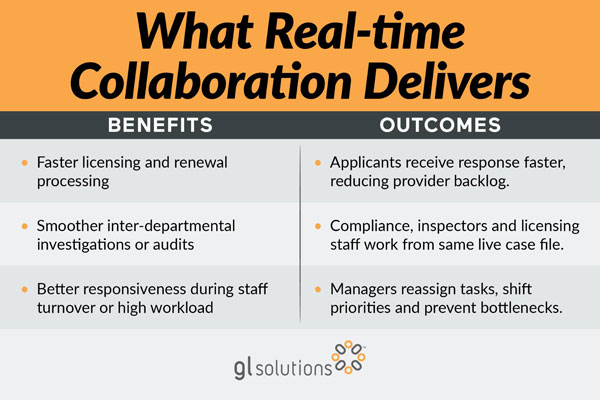
With cloud-based systems your regulatory staff experience fewer silos, fewer duplicate efforts and more transparent coordination.
4. Robust Reporting, Analytics, and Compliance Oversight
Regulatory agencies carry a heavy compliance burden: tracking licensing status, renewals, audits, incident investigations, provider performance, client complaints and service outcomes. A case management system must deliver strong reporting and analytics features.
Typical analytics and reporting use cases:
- Generate custom reports by date range, case type, provider or inspector.
- Identify recurring problems like frequent provider violations, regions with high complaint volumes or audit backlog.
- Monitor staff workloads, case distribution, backlog, pending applications and overdue tasks.
Regulatory agencies that benefit:
- Agencies overseeing elder care licensing, child care licensing or behavioral health licensing, where regulated entities number in the thousands and oversight demands constant trend monitoring
- Regulatory oversight divisions needing transparency for public reporting, legislative reviews or audit readiness
Without built-in reporting, human care regulatory agencies often rely on spreadsheets or manual aggregation, both time consuming and error prone. A modern regulatory case management system elevates reporting and analytics as core functionality, giving your agency clear visibility into performance, trends and workload patterns.
5. Security, Privacy and Data Integrity
Human care regulators manage sensitive personal data, ranging from licensee credentials and background checks to provider records and investigations. GovRAMP-aligned security standards reinforce the protections that safeguard this data, strengthening compliance, accountability and trust across every system interaction.
A proper system must include:
- Role-based access control to ensure only authorized staff view sensitive case data or provider information
- Encryption to protect data from unauthorized access or interception
- Secure authentication, audit logs, version control and regular backups
- Compliance with relevant security standards and regulations (state confidentiality laws, HIPAA where relevant and record-keeping mandates)
Why Regulatory Agencies Need All Five — Not Only One or Two
Some legacy or off-the-shelf software handles only basic case tracking or document management. Those systems might let agencies log cases or store documents, but they lack the workflow flexibility, reporting power, real-time collaboration, security and automation required for modern human care oversight.
When agencies implement only a portion of these capabilities:
- Processing slows under high volume or surges, causing backlogs.
- Investigations stall due to silos or lack of data access.
- Reporting remains manual, limiting oversight.
- Sensitive data remains vulnerable, risking breaches.
Regulatory agencies operate under public accountability and evolving mandates. They need a platform that performs at full capacity, designed for complexity, transparency, scalability and trust.
How GL Suite Delivers These Capabilities for Regulatory Agencies
GL Suite delivers each of these five capabilities, designed specifically for regulatory agencies.
- Configurable workflows support agency-specific tasks: licensing, investigations, audits, renewals, complaint processing and provider oversight.
- Automation reduces manual work; forms populate based on existing data, documents auto-generate, routing works dynamically based on case status, reminders trigger renewals or follow-ups.
- Cloud-based centralized data access promotes collaboration across units or offices.
- Reporting tools and analytics embedded within GL Suite provide insights into case volumes, processing times, resource allocation and workloads.
- Security remains foundational. GL Suite uses role-based permissions, secure hosting, data encryption and audit logging for protecting confidential client, provider or investigation data.
GL Suite provides a platform built for regulatory complexity, compliance and scalability.
What Regulatory Agencies Gain — And Where This Matters Most
- Faster license processing and renewals: Automated workflows reduce the backlog for license applications, renewals and provider registrations.
- Improved oversight and compliance enforcement: Real-time access and audit trails support investigations, license suspensions or revocations and provider audits.
- Efficient resource allocation: Analytics highlight caseload distribution, rising trends or hotspots of complaints and backlog bottlenecks.
- Transparency and public accountability: Detailed records and reporting provide documentation for public reporting requirements, legislative oversight, audits, stakeholder reporting or funding bodies.
- Data security and trust: Sensitive personal and provider information remains secure. Encryption, secure hosting and audit logs protect privacy and support compliance with confidentiality laws and regulations.
Key Questions to Ask When Selecting a Human Care Case Management Platform
Before selecting a solution, evaluate along these lines:
- Does the system support configurable workflows and case types? The system supports configurable workflows and case types, allowing agencies to create custom case categories, data fields, conditional logic and approval flows tailored to licensing, compliance, complaints, audits, renewals and investigations.
- Does the system support automation of routine tasks? The regulatory software supports automation of routine tasks, including intake processing, document generation, automated reminders, electronic signatures and status updates and notifications.
- Does the system support cloud-based, role-based collaboration and remote access? The cloud-based platform supports role-based collaboration and remote access, enabling staff across offices, locations and field settings to access records and updates in real time with secure permissions.
- Does the system offer robust reporting, analytics, and audit capabilities? The system offers robust reporting, analytics and audit capabilities, generating compliance reports, workload metrics, performance dashboards and trend analysis.
- Does the system meet enterprise-grade security, privacy and data integrity standards? The modern digital platform meets enterprise-grade security, privacy and data integrity standards through role-based permissions, encryption, audit trails, secure hosting, reliable backups and alignment with relevant regulatory requirements.
Where Smart Systems Strengthen Human Care Oversight
A comprehensive software solution designed for human care agencies streamlines operations and enhances public trust. With GL Suite, agencies gain a cloud-based platform with these core capabilities — ready for meeting regulatory demands, evolving needs and mission-critical work. Contact us to learn more.
Sam Hardin, Chief Revenue Officer, joined GL Solutions in 2020 with a background in operations management. He is passionate about leadership, enhancing company culture and personal/professional growth. Sam studied business management throughout his undergraduate and graduate studies.
Time to Modernize
GL Solutions helps your regulatory agency run, grow and adapt through modern software and automation that helps solve your agency’s greatest challenges. To learn more, contact us.
To receive the latest regulatory news delivered to your inbox each week, subscribe to our newsletter.